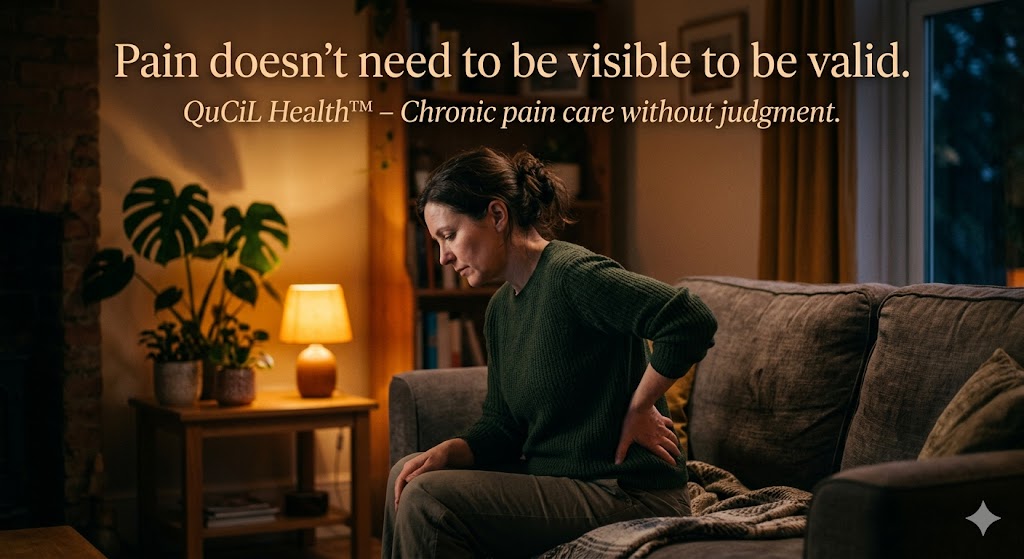
Pain doesn't always announce itself with a limp, a brace, or a visible scar.
For millions of adults living with chronic pain, the hardest part isn't the aching joints, the burning nerves, or the tension headaches that never seem to end. The hardest part is being told:
"But you look fine."
The Isolation of Invisible Pain
When pain persists for three months or longer, it stops being just a physical sensation. It becomes a constant companion that affects sleep, mood, relationships, and the ability to work or care for family.
Yet because many chronic pain conditions — such as fibromyalgia, neuropathy, migraines, and certain autoimmune disorders — have no outward signs, patients often face skepticism from employers, friends, and even some healthcare providers.
This disbelief creates a second layer of suffering: shame, self-doubt, and the exhausting pressure to "prove" you're really hurting.
The Biology of Chronic Pain
Chronic pain is not "all in your head" in the way that phrase is often used dismissively. However, it does involve the brain.
In chronic pain conditions, the nervous system can become dysregulated. Pain signals may continue firing long after an initial injury has healed, or the brain may interpret normal sensations as painful — a process called central sensitization.
This is a real, documented biological phenomenon. It is not weakness. It is not attention-seeking. It is a medical condition deserving of treatment and compassion.
Why Being Believed Matters
Research shows that patients who feel heard and validated by their healthcare provider have better outcomes — not just emotionally, but physically. Trust improves medication adherence, follow-through with treatment plans, and willingness to try evidence-based therapies.
At QuCiL Health™, we start every chronic pain conversation with a simple but powerful statement:
"I believe you."
Beyond Pills: A Whole-Person Approach to Pain
Pain is complex, so treatment should be too. At QuCiL Health™, our approach to chronic pain includes:
-
Thorough assessment – Taking time to understand your full history, not just your symptoms
-
Identifying contributing factors – Sleep disorders, mood conditions, and inflammation often worsen pain
-
Evidence-based options – Including low-dose naltrexone (LDN), lifestyle modifications, and coordinated care
-
Mental health support – Because pain and depression/anxiety are often connected
-
No judgment – We do not label patients or assume the worst
What You Can Do Today
If you live with chronic pain and feel unheard, consider these steps:
-
Keep a simple pain journal – Track when pain occurs, what helps, and what makes it worse
-
Bring a trusted friend or family member to help advocate during appointments
-
Find a provider who specializes in or has experience with chronic pain
-
Ask questions like: "What else could be contributing to my pain?" and "Are there non-opioid options?"
A Final Word
Your pain does not need to be visible to be valid. You are not weak for being tired. You are not a burden for needing help. And you are not alone.
At QuCiL Health™, we see you. We hear you. And we will work with you — not against you — to find a path forward.
Disclaimer: This post is for educational purposes only and is not a substitute for medical advice. Always consult a qualified provider about your specific condition.
Visit Us: 406 Summerset LN, Brookshire, Texas 77423
Call: (832) 930-9797


Community Discussion 0
Privacy Notice
Please DO NOT share: Personal health information or contact details.
Comments are moderated to protect patient privacy.
Share Your Thoughts
No comments yet. Be the first to share your thoughts!